The 2026–2027 ice cave season explained: early vs late November, operator seasons, prices and what happens if the cave isn't ready
The Short Answer
No, November is not too early. Natural blue ice cave tours from Jökulsárlón Glacier Lagoon are already
running in the 2026–2027 season, which opened on 1 October 2026. November is still a shoulder month,
though, so book flexibly, expect possible route changes after heavy rain, and treat late November as
noticeably safer than the first week.
November ice caves at a glance
Early November (1–10): Tours run, but this is still the less stable end of the
season. Rain can flood a cave for a few days, and operators may switch you to blue-ice
tunnels, canyons or a glacier walk instead.
Mid to late November: Your odds improve as the cold sets in, though the ice is
still less stable than in midwinter. Late November is a solid choice if February doesn't work
for you.
Safest months: December to February, and February above all. Guide to
Iceland's 31-year study finds that February keeps the ice frozen through on 18.9% of days,
the highest share of any month, with January second. Seasons and prices change every year, so
confirm with the operator before you travel.
The calendar above is Local Guide of Vatnajökull's Original
Ice Cave Tour on Vatnajökull (4.6/5 from 1,174 reviews on GetYourGuide), which meets at the
Jökulsárlón lagoon. It is the operator whose season updates we quote most below, and it swaps in a
blue-ice tunnel or canyon if no stable cave has formed.
Early vs Mid vs Late November
Inside Vatnajökull National Park, the ice cave season is now fixed by rule at October to
April. Caves are closed from May to September. The park tightened its rules after ice
collapsed on a group of 25 tourists on Breiðamerkurjökull on 25 August 2024, killing an American man
(CBS News/AP). Now, as the Reykjavík Grapevine reported in October 2024, each operator must designate
an experienced lead guide to an assessment group that checks every cave and overhanging ice
formation, such as ice walls and moulins, every day. Tours are allowed in November. What matters is
how good and how stable the cave will be on your date.
Window
What to realistically expect
Our verdict
1–10 November
Tours run. After heavy rain the main cave may be flooded, muddy or temporarily closed,
and you may be sent to alternative blue-ice features. Walks can be long.
Fine for flexible travellers. Book early in your stay and keep a backup day.
11–20 November
More frozen days, but rain-on-snow events still happen.
A good bet if you plan two nights in the area.
21–30 November
Colder, with more of the season's blue showing. Daylight is short, so midday departures
matter.
The best part of November for ice caves.
For everything else at the lagoon in November, from boats and the café to
parking and daylight hours, see our main guide to Jökulsárlón in
November.
Other experiences you might enjoy
An ice cave day pairs well with the rest of the southeast. Browse Vatnajökull ice cave and
glacier hike tours from Skaftafell, the year-round Katla ice cave near
Vík, Jökulsárlón and Diamond Beach tours from Reykjavík and
northern lights tours on the South Coast.
How Jökulsárlón Ice Caves Form and Why Timing Matters
The caves near Jökulsárlón are not permanent attractions. In summer, meltwater runs across and through
Breiðamerkurjökull, the outlet glacier of Vatnajökull that feeds the lagoon with icebergs. The water
carves channels, moulins (vertical shafts) and tunnels. When autumn temperatures drop, the meltwater
stops flowing and the channels drain. Some of them are then dry and stable enough for guides to bring
people inside. Our guide to how Jökulsárlón was formed
covers the glacier itself.
Three things follow from that, and each one changes how you plan:
Each year's cave is new. Glacier Trips puts it bluntly: the cave you visit this
January will not exist next January. Many past caves have already melted away. Ice Walkers, for
example, notes that the "ABC" cave it used in 2025–2026 is gone.
Rain matters more than the calendar. Running water inside the glacier is what
destabilises a cave. Guide to Iceland's study found that heavy rain (about 20 mm) roughly doubles
the chance of a cancellation.
Freeze-thaw weakens the ice. When temperatures swing around 0°C, ice weakens,
water levels jump and passages can flood or collapse. The shoulder months have more of these
cycles than midwinter.
The 2026–2027 cave: Verðandi
This season's main cave on Breiðamerkurjökull is called Verðandi (often
written Verdandi). Local Guide of Vatnajökull describes it as about 200 m long and up to about
15 m wide, set beside the lagoon at the glacier's calving face. Early in the season its
interior was "predominantly dark ice with some blue sections", with a muddy floor. Guide to
Iceland markets the same area as this year's "Crystal Ice Cave". Operators also use smaller
blue-ice features with names like Blami, Top Gun and Goose as alternatives.
The access road to Verðandi
Vatnajökull National Park issued a permit on 25 September 2026 to extend the access road towards
Verðandi. Guide to Iceland says the extension is "expected to be completed in November 2026". In
its 13 October update, though, Local Guide says it "remains pending, with no confirmed work
schedule." Until the road is built, expect a walk of about 1.8–2 km each way to
Verðandi. If you're booking for early November, plan for the longer walk.
What Happened in the First Weeks of This Season
If you are weighing early November, the operators' own condition reports are the most useful
evidence:
1 October 2026: Local Guide reported that tours would run, but "the main large
ice cave is currently inaccessible due to flooding." Ice Cave Tour guests were upgraded free of
charge to the longer Blue Ice Discovery tour.
Around 4 October: Tours to Verðandi resumed. With current access the standard
tour takes about 3 hours 20 minutes, including a walk of about 1.8 km each way.
Last season (2025–2026): Local Guide's archive says October was "unusually warm
and wet." Water drained from several blue ice canyons at the start of November, but conditions
"remained unsettled". An easier-access cave kept flooding after rain, and on one tour water
entered the cave and the group left immediately for a safer alternative.
What this means for you: early-season tours usually go ahead, but the exact
cave, route and walking distance can change at short notice. Book a tour that can visit any safe cave
or blue-ice feature, not one that promises a single named cave.
Ice Cave Season by Month
Month
Natural cave status near Jökulsárlón
Reliability
October
Season opens 1 Oct under park rules. Caves can be muddy, dark or flooded after rain.
Lowest. Guide to Iceland ranks it the least stable month.
Early November
Running. Weather can still force route changes.
Moderate-low
Late November
Running, with colder spells and more blue ice.
Moderate
December
Peak season. Christmas week is the busiest.
High
January
Stable; Guide to Iceland says January has 60% fewer visitors than October.
High
February
The study's most stable month, but also Iceland's windiest.
Highest for ice
March
Usually still good. Caves start to thin.
Moderate-high
April
Tours allowed until the end of April unless conditions close them sooner.
Moderate-low
Guide to Iceland's study scores October, November and April below zero on
its ice-stability index. It also counts warm-rain days, meaning at least 5 mm of rain on a day above
2°C: these fall on 33% of October days, 28% of November days and 25% of February
days. Climates to Travel's 1991–2020 averages for Höfn, the nearest town, give November a
mean of 2.7°C (average minimum 0.1°C, maximum 5.2°C) and 115 mm of precipitation over 14 days, so in
November it often rains instead of snowing.
If your dates are flexible, we think December to February is the right window. If they are not, late
November is a reasonable compromise. Our best time to visit
Jökulsárlón guide compares every month at the lagoon.
Operator Season Comparison (2026–2027)
Prices are "from" figures shown on operator or reseller pages in October 2026 and can change. Some
prices are listed in USD by resellers.
Operator / tour
Season
Duration
Min age
Price from
Meeting point
On GetYourGuide
Guide to Iceland, Crystal Blue Ice Cave (Verðandi)
Group caps: Local Guide 12 per guide, Glacier Trips 14 (8 on Adventures Dream),
Blue Iceland 16, Fjallsárlón 12 per guide.
Gear is included across the board: usually a helmet and microspikes or crampons,
plus a headlamp when needed.
You bring the warm, waterproof layers and proper hiking boots.
Two operators listed above, Fjallsárlón and Glacier Adventure, publish a November
start instead of October. If you're travelling on 1–5 November, check that your chosen tour
has departures loaded for that date.
Our pick from the lagoon car park: Ice Explorers' Vatnajökull
blue ice cave tour from Jökulsárlón (from $195, 4.6/5 from 967 reviews), a 3-hour super jeep
trip with helmet, crampons and a harness if needed. Like every operator here, it promises the best
cave of the season, not a particular one.
What Happens If the Cave Isn't Ready
Operator substitutions are normal. Local Guide states that if no stable cave has
formed it visits "a striking blue ice feature like tunnel or canyon" instead. Glacier Trips says it
always keeps a backup cave and, "in rare cases", focuses on surface features such as crevasses and
moulins. Iceland Adventure Tours sends groups to other caving formations if the main cave is
closed.
Refund rules differ, so read them before you pay
Local Guide: full refund if you cancel 24 h or more before the tour.
Blue Iceland: full refund if you cancel at least 24 h ahead.
Troll / Ice Guide: 24 h, minus a 3% card fee.
Glacier Adventure: 95% refund if you cancel more than 24 h ahead.
Glacier Trips: 100% refund if you cancel more than 48 h ahead.
If the operator cancels for weather or unsafe conditions, these operators offer a
full refund or a reschedule.
Guide to Iceland advertises free cancellation up to 24 hours.
One catch
A tour that runs in poor weather is not refundable just because the day is grey or wet.
Glacier Adventure states this explicitly.
Natural Blue Ice Cave vs Katla vs the Langjökull Tunnel
Plenty of tours sold in November say "ice cave" but go somewhere else. Here's how the three options
differ:
Vatnajökull natural cave (Jökulsárlón)
Katla ice cave (Vík)
Into the Glacier (Langjökull)
Type
Natural meltwater cave, new each winter
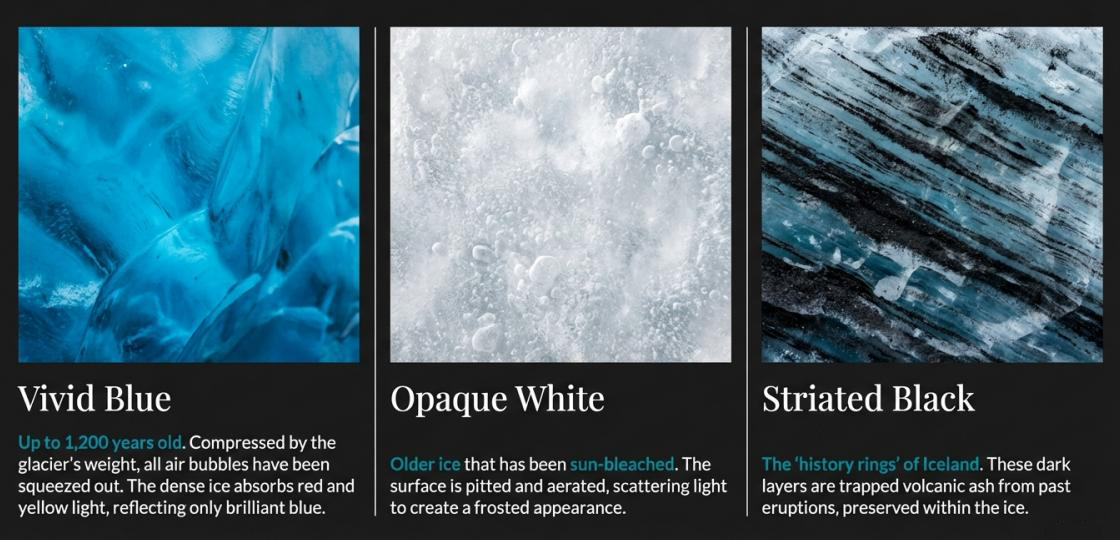
Natural cave in Mýrdalsjökull, black volcanic-ash bands in the ice
Katla is the best backup if you're short on time or doubtful about
early-November conditions near Jökulsárlón: Arctic Adventures' Katla
ice cave and super jeep tour from Vík runs all year with crampons and a helmet included.
The Langjökull ice tunnel tour from Húsafell (4.7/5 from 873 reviews) suits families who want something predictable. Just don't expect either to look like the
famous Vatnajökull photos.
How to Choose the Right November Tour
Self-drive and meet at the lagoon
This works best if you have a car and two nights in the southeast. Book a standard 2.5–3.5 hour tour,
then add a longer tour (cave plus hike) if you're fit and want more blue ice. Read how to get to Jökulsárlón and our weather and
road conditions page first, and compare the options in our self-drive
vs tour guide.
2–3 day tour from Reykjavík
This suits travellers who don't want to drive in winter. Examples:
Reykjavík Excursions' 2-day South Coast and ice cave tour starts from 79,990 ISK.
Small-group 2-day tours sold by Iceland Highlights and Nicetravel start from 84,900 ISK, with
November and December departures listed. On GetYourGuide, Nicetravel's 2-day
South Coast tour with a blue ice cave is from $718 (4.7/5 from 262 reviews), with a night's
accommodation and breakfast included.
Some tours, such as Troll's 2-day Blue Ice Cave & Jökulsárlón tour (4.6/5 from 94 reviews), swap in a longer glacier hike if the cave isn't
accessible. Check what happens in that case before you book.
Private or small group
Pay more for a private tour (from Fjallsárlón or Glacier Adventure, for example) if you want flexible
pacing, photography time or an accompanying child. A private guide won't get you into a cave that's
closed, though.
Booking Tips for November
Book for your first full day in the region. If rain or wind cancels the tour, you
still have time to reschedule, although a later tour may already be full. Guide to Iceland gives
the same advice for shoulder-season trips.
Choose a midday slot. In late November there are only about 5–6 hours of usable
daylight. Guide to Iceland notes that a departure between 10:45 and 13:00 is in daylight on every
day of the season.
Stay nearby the night before. The drive from Reykjavík alone is 5+ hours. Browse
hotels
near Jökulsárlón, or see the hotel list in our November guide.
Check the cancellation window, especially the 48 h policies, and the operator's
conditions page the week before.
Expect company inside the cave. Several operators visit the same cave, and around
Christmas the area is especially busy.
Fitness
Expect up to about an hour or more of walking on uneven, sometimes muddy or icy ground, and longer
while Verðandi's road isn't finished. Wear hiking boots with ankle support, not trainers. For full
layering advice, see what to wear at Jökulsárlón.
Frequently Asked Questions
Yes. In the national park the season opens on 1 October, so tours run on 1 November. Some
operators (Fjallsárlón, Glacier Adventure) list November as their start, so check that
your tour has departures on that date. Expect possible route changes after rain.
Yes. Under the park's current rules, guides assess the caves daily and close any that are
unsafe. Mid-November is less stable than midwinter, which affects which cave you
see more than whether the tour is safe.
Yes, natural caves near Jökulsárlón open on 1 October. October is the least stable and
wettest month of the season, though, and in both 2025 and 2026 the early weeks brought
flooding and route changes.
February is best for ice stability, with January a close second and quieter. Compare the
months in our best time to visit Jökulsárlón guide.
Sometimes. The usual causes are heavy rain, storms, road closures or flooding. More often
the operator swaps in an alternative cave or blue-ice feature. If the operator cancels, you
normally get a full refund or a free reschedule.
Usually from age 8 (Guide to Iceland, Glacier Trips, Blue Iceland, Fjallsárlón) or 10
(Local Guide, Glacier Adventure). Longer hike-and-cave tours are often 14+. For younger
children, Katla (often 6+) or Langjökull are better choices.
Partly. Early-season reports describe mostly dark ice with blue sections, and the blue
usually becomes more vivid as winter goes on. No operator can promise a particular
colour.
Caveats and Sources
This guide is based on operator pages and condition reports available in mid-October 2026. Cave
names, routes, prices and age limits can change during the season.
Some details differ between sources. Arctic Adventures lists the minimum age as 6 on one page and
8 on another. Guide to Iceland and Local Guide disagree on when the access road will be
finished.
Third-party "best month" articles often say the season is "November to March". The park's actual
permitted season is October to April.
Information checked in October 2026. Always confirm dates, prices and conditions directly with your
operator before you travel.
Sources used
Guide to Iceland: The Safest Month to Visit Ice Caves in Iceland (updated 12 Oct 2026), the
Crystal Blue Ice Cave tour page and the Ice Cave Tours hub
Local Guide of Vatnajökull: Ice Cave Tour page and the Iceland Ice Cave Conditions & Season
Updates page (updated 13 Oct 2026)
Glacier Trips: tour FAQ, tour pages and terms
Troll Expeditions: Crystal Blue Ice Cave, 2-Day South Coast and Katla tour pages
Blue Iceland: Crystal Blue Ice Cave Adventure page and terms