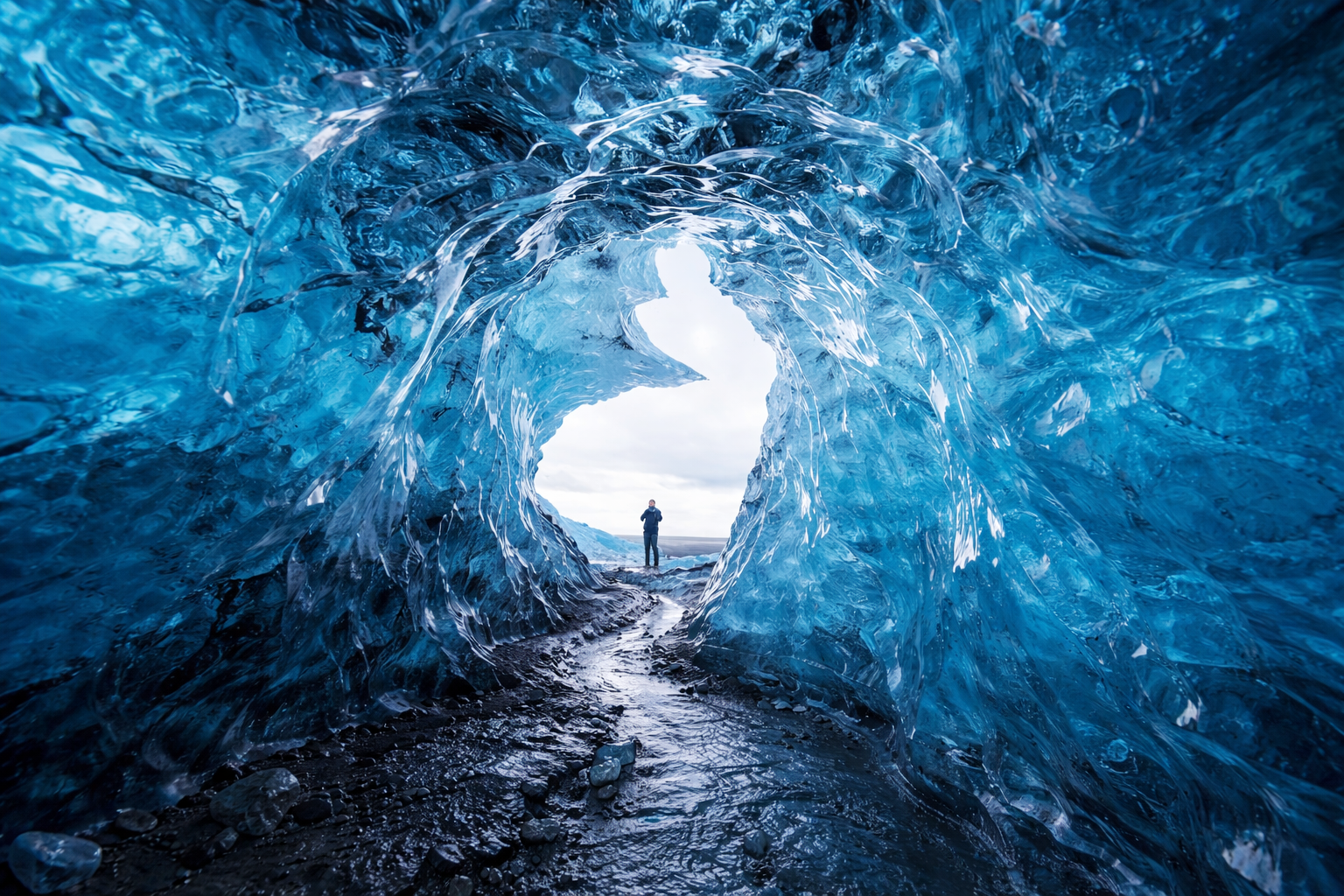
Step inside a masterpiece of nature. Discover the ethereal world of natural blue ice caves carved by time
and transition.
When winter descends on Iceland, the area around Vatnajökull glacier transforms. The cold
temperatures stabilize the ice, allowing expert guides to lead tours into the temporary world of
natural blue ice caves. These brilliant blue caverns are only accessible when
conditions are safe: the national park allows tours from October to April, and the
caves are most reliable from November to March.
Strategic Choice: Most tours are "meet-on-location" in the lagoon parking lot.
However, you can also book all-inclusive day trips from Reykjavík or explore Skaftafell tours for unique
glacier experiences just 45 minutes away. Choosing between these is a
trade-off between the flexibility of self-driving and the effortless logistics of a guided long-haul
trip.
The meeting point for tours is at the Main Lagoon Lot. One fee covers all zones.
Most PopularWinter ClassicSuper Jeep Adventure
Classic Jökulsárlón Ice Cave Tour
★★★★★4.6/5(972 reviews on GetYourGuide)
The classic ice cave tour is a comprehensive adventure. It begins with a meet-up at Jökulsárlón,
followed by a scenic and bumpy ride in a modified Super Jeep. Once at the glacier's
edge, your certified guide provides all necessary safety gear—including a helmet and crampons—and
leads you into a breathtaking natural ice formation.
From the jeep it is a short walk across the ice on crampons to the cave entrance, and a headlamp is
handed out where the cave needs one. The access is rated relatively easy. Most tours last 2.5 to 3.5
hours; versions that add a glacier walk run to about 3.5 to 4 hours.
Key Highlights
Enter and explore a naturally formed, brilliant blue ice cave.
Learn about glacier dynamics from a certified expert guide.
Enjoy the adventure of an off-road ride in a powerful Super Jeep.
All essential safety equipment (helmet, crampons) provided.
Important Considerations
The specific cave changes daily based on safety and conditions.
Popular caves can be crowded; consider "Early Bird" tours to beat the rush.
An unmissable winter-only experience for those seeking Iceland's iconic
blue ice. Perfect for families and those who prefer a thrill-filled Super Jeep ride over a long
hike.
Top-Rated Iceland Experiences
Browse top-rated experiences across Iceland — Jökulsárlón Glacier Lagoon boat tours, winter ice cave tours in Vatnajökull National Park, South Coast day trips from Reykjavík past Seljalandsfoss and Skógafoss, and glacier hikes in Skaftafell — to round out your trip.
Selecting Your Adventure: Accessibility vs. Exploration
Accessible Beauty
Tours like the Classic Crystal Cave focus on reaching a specific cave with
minimal hiking. Most of the "adventure" comes from the Super Jeep ride across the glacier
moraine.
Min. Age: 6 to 10, by operator
Hiking: Very little
Crowds: Potential for sharing space
Deep Exploration
Longer tours (5.5 – 6 hours) prioritize the glacier walking experience.
These involve 4-8 km of hiking across technical terrain to reach remote, serene caves away
from the main crowds.
Min. Age: 10+ or 14+
Hiking: Significant (4-8 km)
Experience: Quiet and immersive
The Reality of Blue Ice
Managing Your Expectations
Ice caves are natural phenomena that change daily.
No two experiences are identical because the ice is constantly shifting, melting, and
re-freezing.
The Light Matters
The "blue glow" is highly dependent on external light and weather. On cloudy days, the ice
may appear darker or more opaque.
Representative Visuals
View promotional photos as representative of the *type* of beauty you'll see, not as an exact
blueprint of the current cave's shape.
⚠️ Critical Safety Note
Glaciers and ice caves are inherently dangerous environments. The raw beauty comes with risks like
collapses and shifting ice. Never attempt to explore ice caves on your own. Booking
a tour with a certified guide who understands the ice and provides professional equipment is
non-negotiable for your safety.
Guides check the caves every day and cancel when the ice is unsafe; take that as a safety call,
not overcaution. The glacier also hides crevasses and moulins (vertical meltwater shafts) away from
the caves. Before you travel, check safetravel.is
and the forecast at vedur.is.
Every natural ice cave near Jökulsárlón is reached by super jeep from a meeting point, never on foot from the car park. What separates the tours is where they start, how long they take, and whether the cave is inside Vatnajökull itself or in the Katla ice cave, about two and a half hours west.
If you are driving and already at the lagoon, only one of these starts where you are parked: the Vatnajökull blue ice cave collects from the main car park beside the café. The Katla tours leave from Vík, so they suit a westbound driving day rather than a detour back east. Katla runs all year, so it is the answer from May to September, when the Vatnajökull caves are closed, and a useful fallback in October and April, at the edges of their season.
Prices are the "from" rate per adult. Prices were checked against GetYourGuide on 25 September 2026, ratings and review counts in October 2026.
Tour
Departs
From
Rating
Length
Operator
Vatnajökull Blue Ice Cave
Jökulsárlón car park
$195
4.6★ (969)
3 hrs
Ice Explorers
Skaftafell Ice Cave & Glacier Hike
Skaftafell (50 min west)
$159
4.5★ (2,005)
4 hrs
Troll Expeditions
Katla Ice Cave and Super Jeep
Vík (2.5 hrs west)
$191
4.6★ (2,628)
3 hrs
Arctic Adventures
Katla Ice Cave & Super Jeep
Vík (2.5 hrs west)
$272
4.7★ (1,523)
3 hrs
Troll Expeditions
Katla Ice Cave Small-Group
Vík (2.5 hrs west)
$180
4.4★ (1,403)
3 hrs
Gravel Travel
Short answer
If you are staying near the lagoon, book the Vatnajökull tour that meets in the Jökulsárlón car park — it is the only one that does not cost you half a day of driving. The Skaftafell ice cave and glacier hike runs on the same October-to-April season, so choose it if you also want a proper walk on the glacier. From May to September only the Katla tours from Vík still go inside a natural ice cave; in winter they make sense if you are already sleeping in Vík.
Crystal, Blue, Natural, Man-Made: What the Names Mean
The words are used loosely in tour listings, and the difference decides what you actually see.
Natural blue ice caves
Melt-water tunnels that form fresh inside the glacier each year and collapse each spring. Summer meltwater carves the channels; once autumn frost stops the flow, they drain and the ice around them is stable enough to enter, until the ice warms again in spring. The deep blue comes from dense, bubble-free ice (our guide to how Jökulsárlón was formed explains the glacier behind it). These are the caves people mean by crystal ice cave or blue ice cave. Most form in Breiðamerkurjökull, the outlet glacier that feeds the lagoon, often on its western side a few kilometres from the car park. Tours run only in winter: the park's season is October to April, and the caves are most reliable from November to March.
Man-made tunnels and other natural caves
Man-made tunnels such as Into the Glacier on Langjökull run all year and are predictable, but the colour is paler. The ice caves on glacier hikes from Skaftafell are natural and follow the same October-to-April season as the caves near the lagoon. Katla's cave near Vík is natural too, in a volcanic glacier, so its ice is streaked black with ash, and its tours run all year.
No operator can promise a specific cave. You never see the same cave twice from one winter to the next: new caves form and old ones collapse every year, and guides scout fresh ones each autumn. Names such as the Crystal Cave, Sapphire Cave or Blue Diamond Cave are labels for whichever caves formed that winter and passed the safety checks, not fixed places. On the day, guides pick the safest one, and the cave in the listing photo may have closed weeks earlier.
The Honest Season Window
Period
Blue caves near Jökulsárlón
Skaftafell cave and hike
Katla (Vík)
Notes
October
Opening
Opening
Running
The park season opens on 1 October; rain can flood new caves
November
Running
Running
Running
More frozen days, and late November is steadier than early
December–February
Peak
Peak
Running
Best colour and most stable ice, shortest daylight
March
Running
Running
Running
Melt begins; caves can close at short notice
April
Closing
Closing
Running
Tours continue into April only when the ice stays cold
This is why a summer search for a Jökulsárlón ice cave turns up so little. From May to September the caves inside Vatnajökull National Park are closed, so a summer "ice cave" tour is either the Katla cave near Vík or a man-made tunnel such as Langjökull's. Check which one a listing means before you pay.
Travelling in early winter? Our guide to ice caves in November compares early, mid and late November and sets out this season's opening dates, operator by operator.
What Cancels an Ice Cave Tour
Rain and warm spells. Melt-water raises the risk of collapse; a mild week in January can shut every cave on the glacier.
High wind. The super jeep track across the glacier is exposed, and the drive is called off well before the cave itself becomes unsafe.
Road closures. If Route 1 shuts west of the lagoon, guests from Reykjavík and Vík cannot reach the meeting point even in clear local weather.
Minimum age. It is set by each operator: 6 with Troll, 8 with most others and 10 with Local Guide for the standard cave tours, while the longer hike-and-cave tours are often 14+. A child under the limit is turned away at the meeting point.
Cancelled tours are refunded or rebooked, but in December and January the next available slot can be several days out. Book the first full day of your stay, not the last, and keep the wind and road conditions page open the night before.
A Winter Day Around the Ice Cave
A cave tour takes about three hours, which leaves time for the rest of the lagoon. The boat tours stop for the winter, but the icebergs on Diamond Beach across the road are at their best in the low winter light, and the dark skies here make the area one of the better places in Iceland to look for the northern lights. If you stay nearby for a night, you can book a daytime cave and still be at the shore after dark when the forecast is good.
Ice Cave FAQ
Common Questions About Ice Caves
Not near Jökulsárlón. Natural blue ice caves like the "Crystal Cave"
only run in winter, from October to April at most and most reliably November to March.
In summer they melt or fill with water. For a natural ice cave in summer, book the
Katla ice cave near Vík, which runs all year.
No. Every year a "Crystal Cave" is found, but it is a new formation each season. Nature
carves a different masterpiece every winter.
Most form inside Breiðamerkurjökull, the outlet glacier of Vatnajökull that
feeds the lagoon. Tours reach them by super jeep from the Jökulsárlón
car park, a few kilometres away.
Centuries of pressure squeeze the air bubbles out of glacier ice, leaving it dense and
clear. Dense ice absorbs the other colours of light and lets blue through, so the oldest,
most compressed ice looks the deepest blue, especially on a bright day.
Yes, with a certified guide. Guides assess the caves every day and cancel when the ice is
unsafe, usually with a refund or a free rebooking. Never enter a glacier cave without a
professional guide.
The standard 3-hour super jeep tours from the lagoon start at about ISK 23,900 booked
direct with Local Guide (about $195), and the Vatnajökull blue ice cave tour on
GetYourGuide starts from $195. Prices vary by operator and inclusions, so compare the
current rates when you book.
Essential Gear: Waterproof/windproof outer layers, thermal base layers
(wool), and sturdy over-the-ankle hiking boots. Rentals for boots and clothing are often
available locally, but check your operator's policy first.
Ready for the Blue?
Winter spots fill up months in advance. Secure your spot now.