The short answer
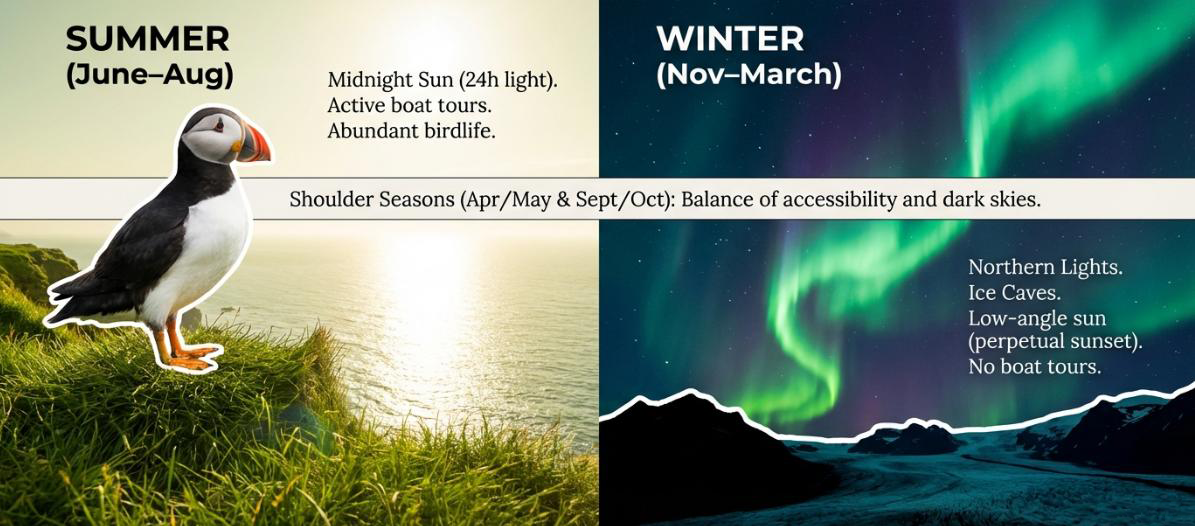
Jökulsárlón has two very different peak experiences, not better and worse versions of one. Summer is for the lagoon boat, long daylight and an easy run along the South Coast. Winter is for the natural blue ice caves and the aurora, and neither of those exists in summer: the sky here never goes properly dark between early April and early September. If it is your first visit and you have no particular objective, late May offers the best overall balance, because the boats have started, May is the driest month at the lagoon, daylight reaches close to 20 hours by the end of the month, and Iceland is at about half its August visitor numbers. If you are coming for a cave or for the lights, book between November and March, when daylight runs from about four hours in December to nearly twelve by March. September and October are the only full months that give you the boats and dark nights together, at the cost of being the two wettest months here.
See what is bookable on your datesChecked 7 September 2026 against Icelandic Met Office station records, Icelandic Tourist Board arrivals figures and the operator's published season. Prices move, so this page sends price questions to the live calendar instead of quoting one.
Summer · May to October
- Lagoon boat tours, both kinds
- Nearly 21 hours of daylight in June
- Easy South Coast driving
- No aurora and no ice caves
Winter · November to March
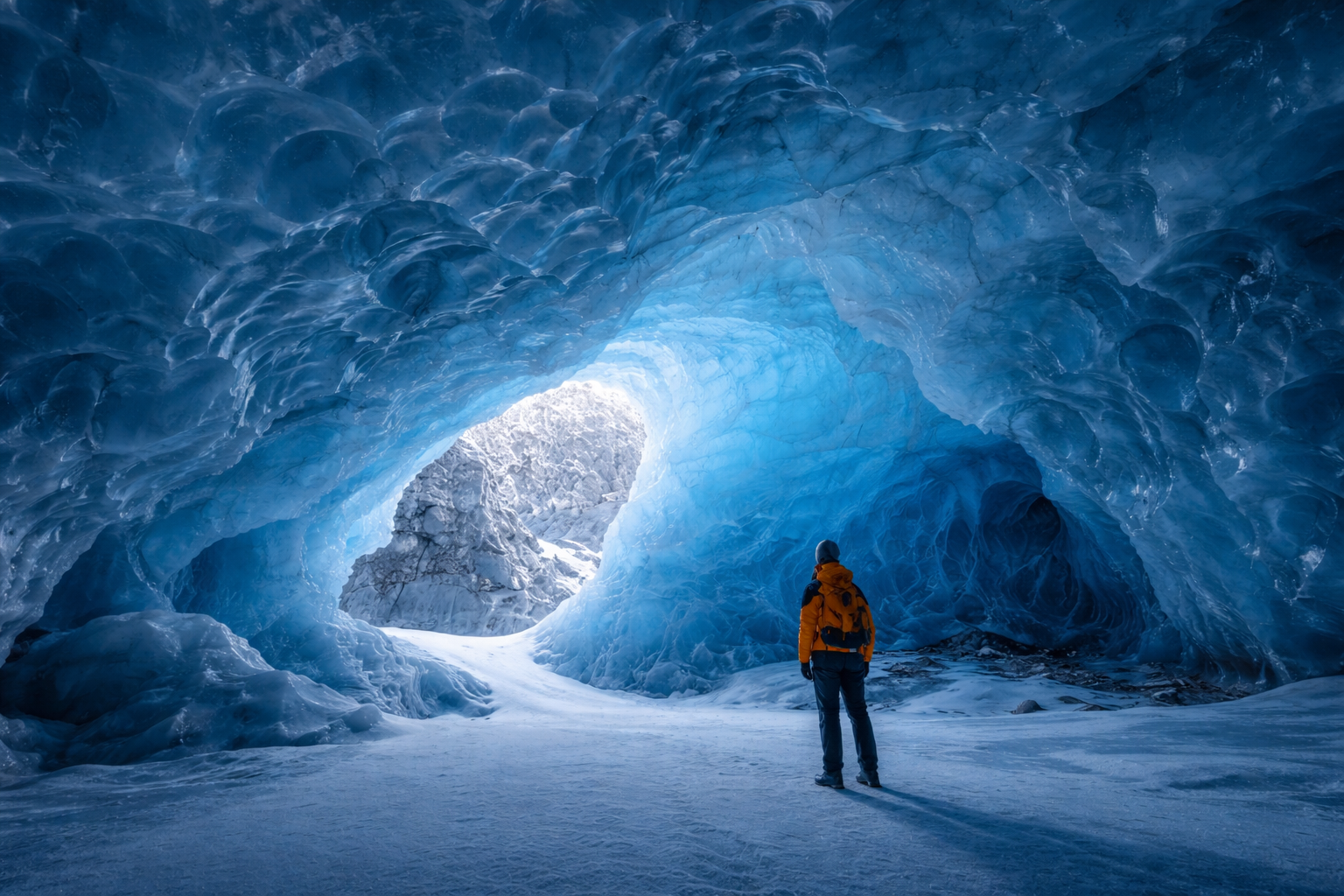
- Natural blue ice caves, guided
- Northern lights once it is dark
- Low sun all day for photographs
- No boats, and about four hours of daylight in December
- 116 mm
- May, the driest month at the lagoon
- 287 mm
- October, the wettest, more than twice May
- 145
- nights with no real darkness, 11 April to 2 September
- 5 hrs
- drive from Reykjavík, each way
No month is a write-off. The lagoon is there year-round, icebergs drift through it in every season, and Diamond Beach is worth seeing whenever you visit. What changes is which tours are running, how much daylight you have, and whether a five-hour journey from Reykjavík makes sense at that time of year.
What runs on your dates
Pick a date to see how long the day is, what is in season, and how wet it is likely to be. Close dates use the live forecast; further-off ones use the monthly average for the lagoon, and the card says which.
Showing a typical July, the middle of the boat season. Pick a date above and this switches to your month, and to the live forecast if the date is close enough.
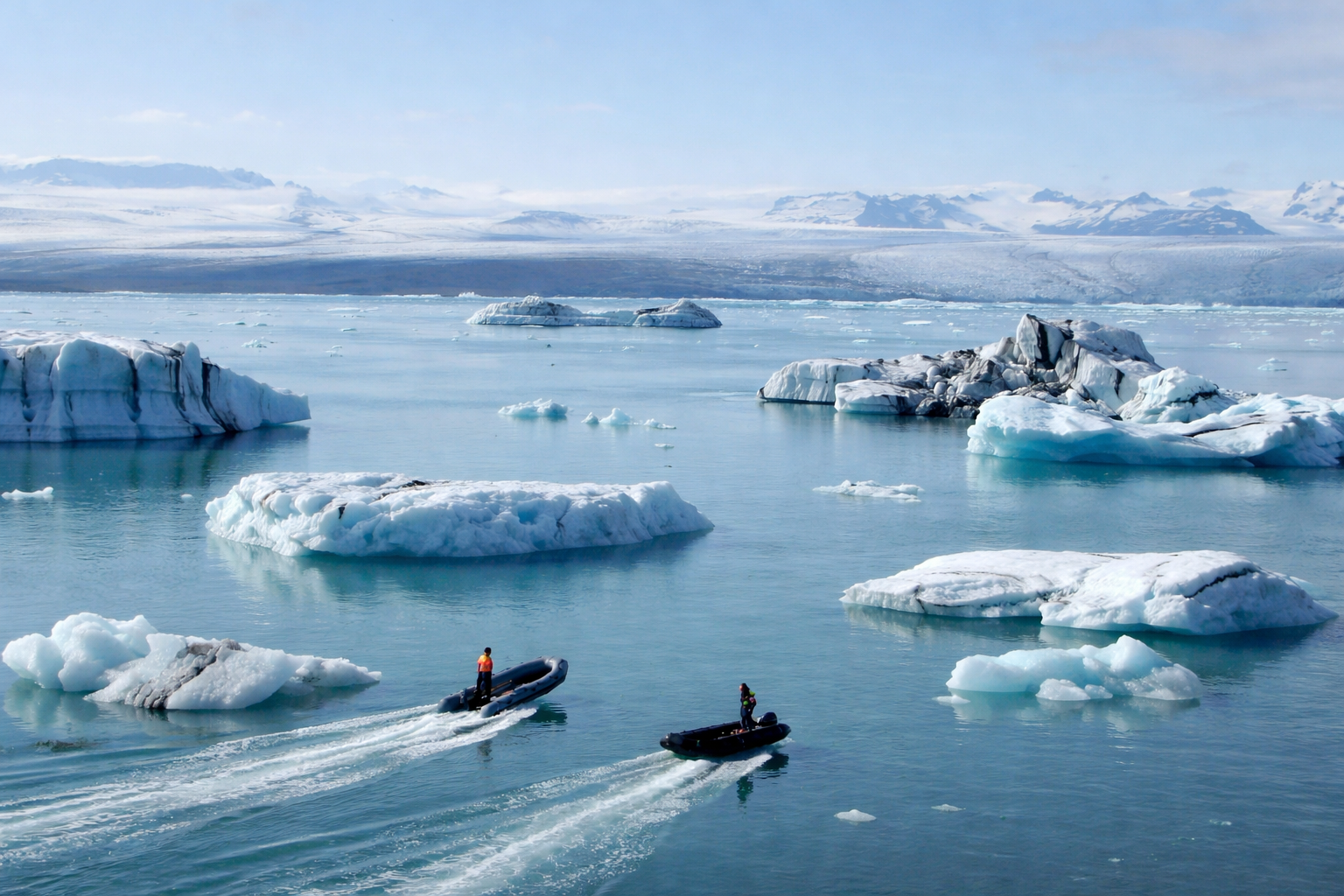
Through the boat season the lagoon is a straightforward day out: the amphibian boat is running, the daylight is long enough to drive down from Reykjavík and back, and rain is the main variable. Outside it, from mid-November until May, the boats stop and the blue ice caves take their place.
Check lagoon boat datesFull day from Reykjavik with the lagoon boat ride included. Rated 4.67 from 251 reviews.
Check real dates and prices
Live calendar for the year-round lagoon day trip, the one option that depends on neither the boat season nor the caves.
Month by month at the lagoon
Rain and temperature are Icelandic Met Office station records. Daylight is computed for the lagoon's own latitude. The visitor column is an index against the busiest month of the year, taken from national arrivals figures. It measures pressure on Iceland, not heads at the lagoon.
| Month | Rain | Mean °C | Daylight | Visitors (Aug = 100) | Lagoon boat | Blue ice caves |
|---|---|---|---|---|---|---|
| January | 227 mm | 1.1 | 5h 24m | 42 | Not running | Open |
| February | 184 mm | 0.7 | 8h 35m | 50 | Not running | Open |
| March | 177 mm | 1.4 | 11h 38m | 55 | Not running | Open |
| April | 161 mm | 3.8 | 15h 00m | 49 | Not running | Closing, cold years only |
| May driest | 116 mm | 6.5 | 18h 18m | 54 | Season opens | Not running |
| June | 134 mm | 9.1 | 20h 57m | 78 | Running | Not running |
| July | 119 mm | 10.7 | 19h 45m | 98 | Running | Not running |
| August | 157 mm | 10.7 | 16h 28m | 100 | Running | Not running |
| September | 277 mm | 8.4 | 13h 07m | 76 | Running | Not running |
| October wettest | 287 mm | 5.0 | 9h 55m | 71 | Zodiac ends | Not running |
| November | 196 mm | 2.5 | 6h 36m | 52 | Amphibian only, to mid-month | Season opens |
| December | 234 mm | 1.3 | 4h 17m | 45 | Not running | Open |
Boat dates follow the operator's published season, which is May to November for the amphibian boat and May to October for the Zodiac, both subject to ice and weather. Cave dates are the usual November to March window; the caves melt out and reform every year, so nobody can promise a specific one.
Which season is right for you?
There is no single best month here, and a page that named one would be picking a side in an argument the evidence does not settle. What there is, is a clear answer for each reason people come. Find your reason on the left.
| If you are here for… | Go |
|---|---|
| First visit, no specialist objective | Late May into early June. Boats running, the driest month at the lagoon, close to 20 hours of daylight, and Iceland at about half its August visitor numbers. |
| Lagoon boat tour | May to October for both boats; the amphibian keeps going to mid-November. |
| Natural blue ice caves | November to March, guided access only, sometimes into April after a cold spring. |
| Northern lights | September to March. Darkness returns on 2 September and there is none at all before it. |
| Longest daylight | June, at 20h 57m mid-month. |
| Boats and aurora on the same trip | September and October, the only full months with both. |
| Fewest people | January and December, at a little over 40 per cent of the August peak, though you trade almost all the daylight for it. |
| Photographing Diamond Beach | December and January: the midday sun reaches only about 2.5 degrees, so the light comes at the ice from the side all day. |
The two rows that decide most trips are the boat and the ice caves, and they point in opposite directions. That is the whole shape of this place: the lagoon boat and the ice caves are not a better and a worse version of the same day out, they are two different trips that happen at the same lagoon six months apart.
Other experiences around the south coast
Ice caves under Vatnajökull, glacier hikes on Falljokull from Skaftafell, south coast day trips from Reykjavík past Seljalandsfoss and Skógafoss, and boat trips on the quieter Fjallsárlón lagoon next door.
What the lagoon does through the year
Rain totals and visitor counts are the frame around the picture. This is the picture: what is actually happening at the lagoon and on the black sand plain behind it in the month you are thinking of.
The dark comes back on 2 September
The aurora season here is set by geometry, not by solar activity. Between 11 April and 2 September the sky at Jökulsárlón never reaches astronomical darkness at all — 145 nights when the sun stays close enough to the horizon to keep a glow in the sky. You cannot see the northern lights in June however strong the forecast is. Darkness returns at the start of September and deepens fast: 4h 39m a night by mid-September, 8h 46m by mid-October, and close to thirteen hours through December.
September and October are therefore the only full months with both the boats running and a sky that goes properly dark, which is why photographers favour them. Early November manages it too, until the boats stop.
Terns from May, and gone by September
The Arctic terns arrive from the South Atlantic in late April and May, nest on the flat ground beside the lagoon through June and July, and have left by the end of August. If you walk near a colony in June they will dive at your head; they defend their nests hard. Egg collection by rights-holders is banned after 15 June, which is a fair marker for when the eggs are in the nests.
They are not doing well. The Icelandic Institute of Natural History lists the tern as Vulnerable and has revised the national estimate down to 150,000 to 250,000 pairs, with the decline since 2005 tied to the collapse of the sandeel they feed on.
The skuas on Breiðamerkursandur are nearly gone
The sand plain the Ring Road crosses at the lagoon is one of the great skua's core breeding grounds. It held 2,820 pairs in 1985. The national population has fallen from about 5,400 breeding pairs in the mid-1980s to roughly 400 pairs in breeding condition in 2023 and 2024, and the species is now listed as Critically Endangered. If you are here in June or July you are looking at a colony that has lost most of itself inside one human lifetime.
Seals are easiest to see from late July
Harbour seals use the lagoon, and they are hardest to miss during the summer moult. The Marine and Freshwater Research Institute flies its national census from the end of July to the end of August precisely because that is when the animals haul out in numbers, which is also when a visitor is most likely to see them lying on the ice instead of surfacing as a head in the water.
The national count has fallen from about 33,000 animals in 1980 to under 7,000 in 2016, a third of that drop coming between 2011 and 2016.
The caves are cut fresh every winter
The blue ice caves are not permanent features. They melt out and reform inside Breiðamerkurjökull each year, park rangers are responsible for them, and the cave in the photograph that made you want to come may not exist this winter. The season runs roughly November to March, sometimes into April after a cold spring.
The ice itself does not have a season
Icebergs are in the lagoon in every month. The glacier calves into it continuously and a narrow channel carries ice out to the sea and washes some of it back onto Diamond Beach. No public record measures iceberg size or density month by month, so this page makes no seasonal claim about it.
Which trip fits your dates
There are really only three decisions here, and the month makes most of them for you. Each option below is the highest-rated one in its category with enough reviews behind it to mean something.
The boat is why you came
May to mid-November
A full day from Reykjavík with the lagoon boat ride built in, so the one thing you came for is not an optional extra you queue for on arrival.
- Rated 4.67 from 251 reviews
- 14 hours, so it needs a long day: fine from May to August, tight by late October
- Stops on the south coast on the way, which is what saves a wet day
The ice caves are why you came
November to March
Three hours, starting from Jökulsárlón itself rather than from Reykjavík. In a December day of 4h 17m, not spending five of them on the road is the whole point.
- Rated 4.64 from 944 reviews
- 3 hours, which fits inside a short winter day
- Needs you to be near the lagoon already, so plan a night at Höfn or Skaftafell
Your dates are fixed and awkward
All year, including April
The lagoon and Diamond Beach without the boat or the caves. This is the booking for April, for a mid-November gap, or for anyone who does not want the day to hang on one seasonal product.
- Rated 4.68 from 3,758 reviews, one of the most-reviewed lagoon day trips on the platform
- 14 hours, running the whole year
- No boat included, so the lagoon is a shoreline walk and a long look at the ice
How much daylight will you have?
Daylight decides what you can actually do here more than temperature does. Jökulsárlón is about five hours from Reykjavík, so a fourteen-hour day trip in a 4h 17m December day is mostly driving in the dark, and the lagoon itself gets whatever is left. That is why the winter cave tours that start from the lagoon are a different proposition from the ones that start in the capital.
The figures below are sunrise to sunset, computed for the lagoon's latitude, not measured.
- June solstice: about 21 hours, the longest day of the year
- 18h 18m in May, 13h 07m in September, the two ends of the comfortable driving season
- 4h 17m at the December solstice, with the sun barely clearing the ridge
Jökulsárlón does not get the midnight sun, although it is often described that way. It sits roughly 280 km south of the Arctic Circle, so the sun sets every night of the year, including at the solstice. What you get in June is a long twilight that never becomes properly dark, which is genuinely beautiful and is not the same phenomenon.
How much rain is 287 mm?
It is the total depth of rain that falls in an average October, measured across the whole month. It is not a daily rate, and the number says nothing about how many days were wet or how long the rain lasted. A month with one enormous storm and a month of steady grey drizzle can total the same. Spread evenly, 287 mm would be about 9.3 mm a day, but rain does not fall evenly and that figure is a comparison, not a forecast.
What it does support is a narrow claim: an average October at Jökulsárlón delivers more than twice the rain of an average May, so wet weather is simply a larger part of what October is. It does not mean rain is twice as likely, or that there are twice as many wet days. Those are different measurements and this page does not have them.
That shape is not an artefact of one rain gauge. Every Met Office station around the lagoon puts May at the bottom of the year and September or October at the top, so it is a real feature of this coast rather than a quirk of the gauge nearest the car park.
A wet forecast is mostly a reason to choose a different trip rather than to write off the day. The lagoon reads well under cloud, the ice does not care, and a guided day trip with stops along the south coast absorbs bad weather far better than a self-drive does, because someone else is deciding whether the road is sensible.
How busy is it, really?
September is often described as Iceland's thin-crowd shoulder season. The arrivals figures do not show that here. September comes within two per cent of June and runs about 40 per cent above May, so it is not a quiet month; it is a summer month with worse weather, and the car park will tell you so.
The genuinely quiet stretch is winter and early spring. January and December run at a little over 40 per cent of the August peak, with April and February close behind. If thin crowds are the priority, that is where they are, and you will be trading almost all of the daylight for them.
If you want thin crowds with the boats still running, there are two windows: May, and the first half of November before the boat season ends. November is fractionally the quieter of the two. May gives you nearly three times as much daylight, which is most of the reason it comes out on top.
This is a proxy, and the gap needs stating plainly. It counts people arriving in Iceland, not people standing at Jökulsárlón. It cannot tell you how many coaches are in the car park on a given morning, and the lagoon's own share of national arrivals may well move differently. What it does settle is the shape of the year.
What closes in winter, and what opens
This one is a flat no rather than a maybe: there are no boat tours on Jökulsárlón between mid-November and the end of April. The operator's season for the amphibian boat is May to November and for the Zodiac May to October, and both stop early when ice and weather make the lagoon unnavigable. If you have booked February and were hoping for the boat, that is better to know now than at the shore.
What opens instead is the reason a lot of people come at all. Natural blue ice caves form inside Vatnajökull from roughly November to March, sometimes into April after a cold spring. They are not permanent: they melt out and reform each year, guides assess them daily, and no honest operator will promise you a specific cave. January and February are the coldest weeks of the year here, and operators generally treat mid-winter as the most dependable stretch, though nobody publishes a month-by-month record. What is checkable is the daylight: 4h 17m in December against 8h 35m in February and 11h 38m in March, so the later you go in the season the more of the day you get, and the more you are betting on a cold spring.
Winter does something for Diamond Beach that summer cannot. At the December solstice the sun climbs only about two and a half degrees above the horizon at midday, against nearly fifty in June, so for the whole of the short day the light comes at the ice from the side, not from above. If photographs are the point of the trip, that is a real argument for coming when the boat is not running, and the photography guide goes into the light in more detail.
The other winter constraint is the road. The Ring Road here is exposed, closures are common, and a hire car without proper tyres is a bad idea between November and March. If you would rather not make that call yourself, the self-drive versus guided tour comparison sets out what each costs you, and safetravel.is carries the official alerts.
Common questions
What is the best month to visit Jökulsárlón?
If your dates are flexible, late May into early June. May is the driest month at the lagoon, averaging 116 mm against October's 287 mm, the lagoon boats have started their season, there are about 18h 18m of daylight, and visitor numbers across Iceland run at about 54 percent of the August peak. If you are coming for the blue ice caves instead, aim for the back half of their season: daylight runs from about four hours in December to nearly twelve by March, though a warm spring can close them before March is out.
Can you do a boat tour on Jökulsárlón in winter?
No. The lagoon boats do not run in winter. The operator lists the amphibian boat as a May to November season and the Zodiac as May to October, and both stop when ice and weather make the lagoon unnavigable. From mid-November to April you can still walk the shore and visit Diamond Beach, and the ice caves are open instead, but there is no boat.
Is September or October better at Jökulsárlón?
September, on most measures. Both are wet, and they are the two wettest months of the year at the lagoon at 277 mm and 287 mm, but September still has 13h 07m of daylight against October's 9h 55m, and the lagoon boats are running normally instead of winding down. October's advantage is that it is the quieter of the two, at 71 against September's 76 on the visitor index, and it is the last month with the Zodiac boats running.
Is September a quiet month in Iceland?
Not really. Icelandic Tourist Board arrivals figures for 2023 to 2025 put September within two percent of June and about 40 percent above May. It is quieter than July and August, but it is not a low-season month, and the autumn is often described as the thin-crowd shoulder, but the arrivals figures do not show that here.
Does Jökulsárlón get the midnight sun?
No, though it comes close. The lagoon sits about 280 km south of the Arctic Circle, so the sun does set every night of the year. At the June solstice there are about 21 hours between sunrise and sunset and the few hours between are only twilight, which is bright enough to walk the shore but is not the true midnight sun you get in northern Norway or Svalbard.
When are the blue ice caves open?
Roughly November to March, sometimes into April in a cold year. The natural caves melt out and reform every season, so no operator can promise a specific cave, and a warm spring closes them early. January and February are the coldest weeks of the year here, and operators generally treat mid-winter as the most dependable stretch, though no month-by-month record is published. Check live dates on the booking widget instead of planning around a fixed date.
How much rain does Jökulsárlón actually get?
The station nearest the lagoon averages 116 mm in the driest month, May, and 287 mm in the wettest, October. Those are total depths for a whole month, not daily rates, and they say nothing about how many days were wet. A month with one storm and a month of steady drizzle can total the same.
How we know this
Every figure on this page comes from a named public source, and the page is generated from those data files, not typed by hand, so a refresh cannot leave a stale number behind in a table.
- Rain. Veðurstofa Íslands, the Icelandic Meteorological Office. Station Hali, station 738, Sudursveit, about 10 km east of the lagoon, monthly series, averaged over 1998-2016, the station's whole record inside the 1991-2020 reference window. Cross-checked against four other stations around the lagoon.
- Temperature. Veðurstofa Íslands, station Fagurholsmyri, station 745, about 32 km west of the lagoon, averaged over 1991-2008, the station's whole record inside the 1991-2020 reference window, and cross-checked against Höfn i Hornafirði for 2007 to 2018, which agrees within half a degree in every month. Published tables live at vedur.is.
- Daylight. Computed with the NOAA solar position algorithm for 64.048°N, using the standard 90.833° zenith. Computed, not observed, so treat it as accurate to the minute and no finer.
- Darkness and sun angle. Computed the same way. Astronomical darkness is the sun more than 18 degrees below the horizon, which is the threshold that matters for the aurora; there is none at all at this latitude between 11 April and 2 September. Midday sun altitude is 2.5 degrees at the December solstice and 49.4 at the June one.
- Birds. Náttúrufræðistofnun, the Icelandic Institute of Natural History, species accounts for the Arctic tern and the great skua: status, national population estimates and the 1985 count for Breiðamerkursandur. Full URLs are in the page's data file.
- Seals. Hafrannsóknastofnun, the Marine and Freshwater Research Institute, harbour seal census pages: the moult timing that sets the survey window, and the 1980 to 2016 population figures.
- The caves and the sands. Vatnajökulsþjóðgarður, Vatnajökull National Park, whose rangers are responsible for the ice caves in Breiðamerkurjökull and who list the birds that nest on Breiðamerkursandur.
- Visitor numbers. Ferðamálastofa, the Icelandic Tourist Board, monthly arrivals through Keflavík, three-year mean for 2023 to 2025, from the published spreadsheet at ferdamalastofa.is.
- Season dates. The lagoon boat operator's own published season at icelagoon.is. Ice cave dates are the industry-wide November to March window, and this page routes date questions to the live booking calendar instead of printing a schedule.
The rain figures, station by station
Five stations, each averaged over its own record inside the 1991 to 2020 window. They are listed here instead of in the body because the station a figure comes from matters to whether you believe it, and not to which month you book.
| Station | May | September | October |
|---|---|---|---|
| Hali 738 (10 km E) | 116 mm | 277 mm | 287 mm |
| Fagurholsmyri 745 (32 km W) | 103 mm | 190 mm | 197 mm |
| Kvisker 740 (45 km W) | 196 mm | 419 mm | 403 mm |
| Skaftafell 748 (55 km W) | 91 mm | 190 mm | 156 mm |
| Hofn 705 (80 km E) | 76 mm | 180 mm | 184 mm |
Kvísker sits directly under the glacier and is one of the wettest places in Iceland, which is why its figures sit so far above the rest. It is included because the shape of its year matches the others, not because its totals apply at the lagoon.
What these numbers cannot tell you
- Monthly averages are not a forecast. A dry May and a wet one both exist; the average only says which way to bet.
- Rainfall totals do not count wet days. They cannot tell you the odds of a dry afternoon on your date, and this page does not have a wet-day series for the lagoon.
- No station within reach of Jökulsárlón holds a complete 1991 to 2020 record, and the Met Office does not publish 1991 to 2020 normals for these stations. Each figure is that station's own observations inside the window, with the year count in the data file.
- Arrivals through Keflavík are a proxy for pressure on the country. They do not count people at the lagoon, and they cannot tell you how full the car park is.
- The bird and seal figures are national counts, apart from the 1985 skua count for Breiðamerkursandur. They describe a trend, not what you will see on a given morning, and nobody publishes a monthly count for this lagoon.
- We do not have per-date fares, so this page names no cheapest month, and it quotes no prices at all. The booking calendar is the truth on price and availability.
- Season windows are the operator's published intention. Ice and weather close things early, and no schedule here is a guarantee.
Ready to pick a date?
Whichever month you have, the calendar knows what is actually running on it.
Browse Jökulsárlón tours