Ice caves, daylight and what's open at the glacier lagoon between the boat season and midwinter
November at the Glacier Lagoon
November is a transition month at Jökulsárlón Glacier Lagoon. The boats are winding down: the
Zodiac has already stopped, and the amphibian runs only until around mid-November. The natural blue
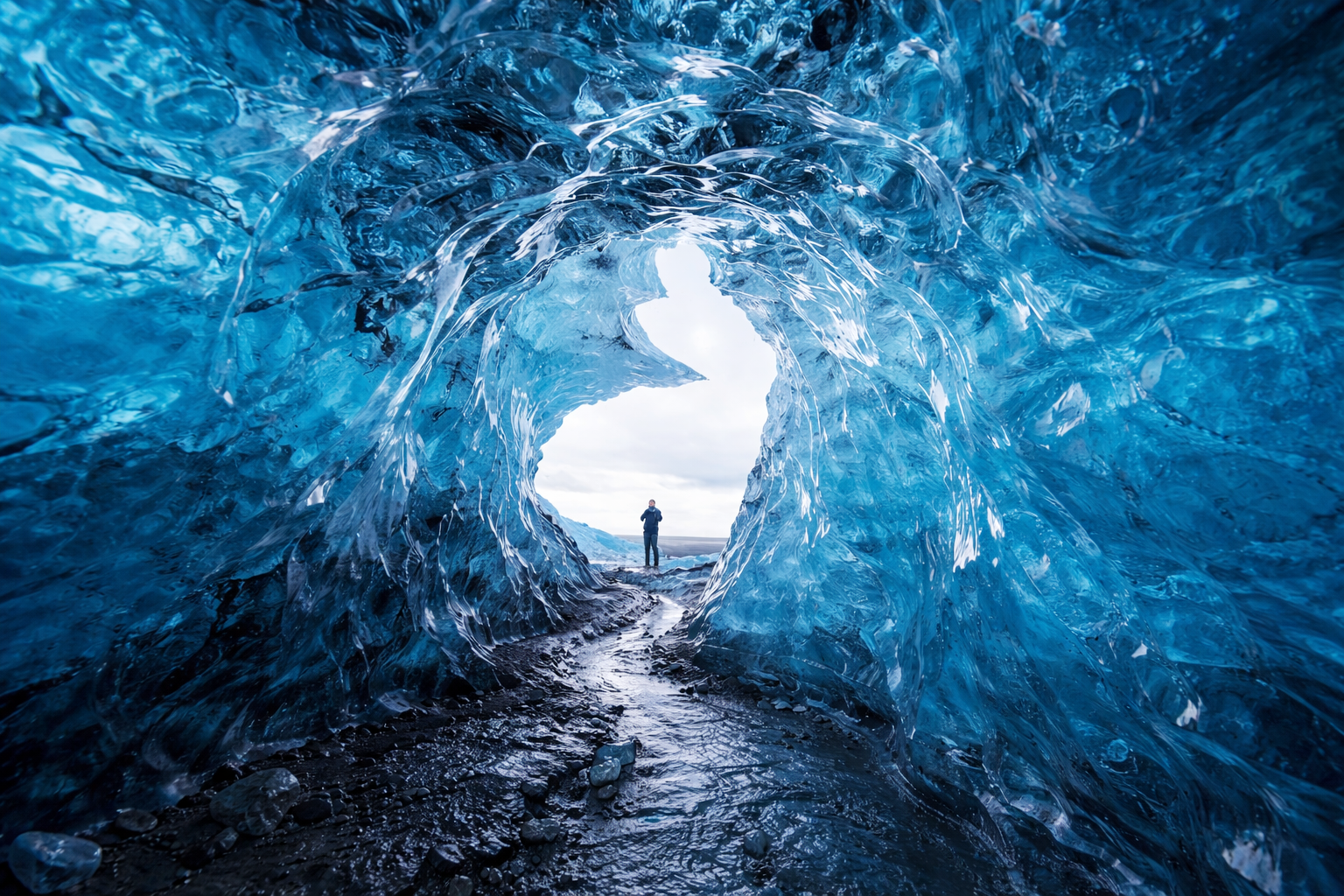
ice caves are just opening. You get roughly 8 hours of daylight at the start of the month and well
under 6 by the end.
November in three lines
Boats: The Zodiac season ends on 31 October. The amphibian boat is listed
"May–Nov", with tour hours published only until 15 November, so treat any November boat ride
as a bonus, not a plan.
Ice caves: Super jeep ice cave tours leave from the Jökulsárlón car park,
but early November is the least reliable part of the season. If the cave is your main
reason to go, book for the second half of the month and keep a backup day.
Logistics: Plan for about 8 hours of light on 1 November, shrinking to
roughly 5½ by 28 November. You need winter tyres, a daily look at road.is and vedur.is, and
at least one night near the lagoon; a 14-hour day trip leaves little time there.
The calendar above is the Vatnajökull
blue ice cave tour from Jökulsárlón (rated 4.6/5 from 967 reviews on GetYourGuide, from $195).
It meets next to the café at the lagoon, so you can book it for your first morning in the area.
November at Jökulsárlón works best for travellers who plan for the gap between seasons. Below is what
is open, what is not, and how to plan around short days and changeable weather. All dates come from
operator and official pages checked in October 2026. Every tour here depends on the weather, so
confirm with the operator before you lock anything in.
November at a Glance
What
November status (2026)
Amphibian boat tour
Season listed "May–Nov"; published tour hours 10:00–17:00 only "Oct – 15th of Nov"
Zodiac boat tour (Jökulsárlón)
Closed: the season is May to 31 October
Fjallsárlón Zodiac tour
Listed April–November by the local operator; ends earlier if the lagoon freezes
Natural ice cave tours
Opening; availability thin early in the month, better from mid-November
Daylight (Höfn area)
~08:41–16:49 on 1 Nov; ~10:08–15:30 on 28 Nov
Average temperature
Around 1°C (lows near -1°C, highs 3–4°C)
Café at the lagoon
Open daily (hours shorten for winter)
Parking
Paid daily fee via Parka; covers the lagoon and Diamond Beach lots
Northern lights
Good darkness; cloud is the main limit
Other experiences you might enjoy
November trips to the lagoon usually take in more of the south coast. Browse ice cave tours in
Vatnajökull National Park, glacier hikes in Skaftafell, the Katla ice
cave near Vík, northern lights tours and South Coast day trips from
Reykjavík past Seljalandsfoss and Skógafoss.
Are Jökulsárlón Boat Tours Running in November?
Only partly, and only early in the month. The lagoon's boat operator (icelagoon.is) lists the
Zodiac as "May–Oct", and its booking page states that Zodiac tours "operate from
may till the end of October." The amphibian boat is listed as "May–Nov", but its
published tour opening hours stop at "Oct – 15th of Nov: 10am – 5pm." The same operator's FAQ also
says boat tours "usually operate from early May through October, depending on weather and ice
conditions", a hint that November sailings are conditional, not guaranteed.
What that means in practice:
1–15 November: An amphibian ride (30–40 minutes, 2026 adult price 7,100 ISK) is
possible if ice and wind allow. Don't plan your trip around it.
After mid-November: Assume no boats on Jökulsárlón until the following May.
Fjallsárlón: The local operator, Fjallsárlón Iceberg Boat Tours, lists its
75-minute Zodiac tour (11,300 ISK, age 5+) as running April–November. It also lists a year-round
"ice floating" experience (5.0/5, but from only 8 reviews on GetYourGuide) and winter "Aurora Huts" for October–November. Fjallsárlón can freeze
in cold spells, which ends boating early.
If being on the water among the icebergs matters most, October is the safer month. If you want ice
caves, late November or later is better. Our Jökulsárlón boat tours guide
compares the amphibian and the Zodiac for the months they do run.
When Do the Ice Caves Open? Early vs Late November
Natural blue ice caves in Breiðamerkurjökull, an outlet glacier of Vatnajökull, are carved each year
by meltwater and only become safe to enter once the cold arrives. Operators publish different
"official" seasons, which is why travellers get confused:
Guide to Iceland's listing for the original Crystal Blue Ice Cave tour from the Jökulsárlón car
park shows "Oct.–Apr.", 3 hours, minimum age 8. On GetYourGuide: Guide to Iceland's Jökulsárlón ice cave tour (4.2/5 from 2,180 reviews).
Arctic Adventures lists its Crystal Ice Cave super jeep tour from Jökulsárlón as
Oct–Apr, 2–3 hours, minimum age 6. On GetYourGuide: Crystal Ice Cave from Jökulsárlón (4.2/5 from 1,762 reviews).
Blue Iceland's Crystal Blue Ice Cave Adventure gives 2.5–3.5 hours and a minimum age of 8.
Fjallsárlón's Vatnajökull Premium Ice Cave tour is listed Nov–Mar (3–3.5 hours,
19,425 ISK).
So do ice caves open on 1 November or in mid-November? Bookings may be on sale from 1 November,
or even October, but the caves themselves depend on sustained cold. Independent guides
consistently describe November as the opening phase, with availability better from mid-November and
the most reliable conditions from December to February.
What a tour looks like this season
On the Crystal Blue Ice Cave tour, you meet at the Jökulsárlón car park and ride a super jeep
for about 30–40 minutes to Breiðamerkurjökull. From there you walk roughly 30–40 minutes each
way over mostly flat ground to a cave the operator calls Verðandi this season, and spend
around 30–45 minutes inside. Helmets, microspikes and headlamps are provided. The listing
says an extension to the access road is expected to be completed in November 2026, which
would shorten the walk. That is the operator's plan, so don't count on the shorter route yet.
If the cave isn't ready
Small operators such as Glacier Trips say they offer alternatives, and refund the price
difference, if the cave is inaccessible. Most tours can be booked with free cancellation up to
24 hours ahead. Book the cave for your first day in the area, so a weather cancellation
still leaves you a second chance, although a later tour may already be full.
Our pick: the Vatnajökull
blue ice cave tour from Jökulsárlón (from $195, 4.6/5 from 967 reviews), a 3-hour super
jeep trip with Ice Explorers that leaves from beside the lagoon café, with helmet and crampons
included.
Iceland stays on GMT all year, so there is no clock change to worry about. Using Höfn, about 80 km
east of the lagoon, as the reference:
Date
Sunrise
Sunset
Approx. daylight
1 Nov
08:41
16:49
8 h 08 m
10 Nov
09:10
16:20
7 h 10 m
19 Nov
09:40
15:53
6 h 13 m
28 Nov
10:08
15:30
5 h 22 m
Jökulsárlón is farther west, so sunrise and sunset there fall a few
minutes later than in Höfn. You also get usable twilight on either side, but plan your driving so
the long stretches happen in daylight.
Weather
Long-term averages for Höfn put November's mean temperature around 1°C, with lows near -1°C and
daytime highs of about 3–4°C. Precipitation figures vary by dataset, from roughly 118 mm to over
200 mm for the month, with rain or snow on about 13–14 days. Expect it to be wet, windy and
changeable, with a mix of rain, sleet, snow and the occasional crisp, clear spell. The wind chill on
the open sands of Breiðamerkursandur is what catches people out. Our Jökulsárlón
weather and road conditions page has the live forecast.
Getting There: Driving vs Tours
Self-drive
The lagoon sits right beside Route 1, about 370–390 km east of Reykjavík depending on where you start.
That is roughly 5 hours of driving in good conditions, and more in November. What that means this
month:
Tyres: Studded tyres are allowed, but not compulsory, in Iceland from 1 November
to 14 April, according to Camping Iceland's driving guide, and rental cars are fitted with winter
tyres for the season. Ask your rental company what is on the car.
Check every morning: road.is (the Road and Coastal Administration) for closures
and conditions, vedur.is for weather warnings, and safetravel.is for alerts. You can leave a
travel plan on safetravel.is.
Storm days happen. The Ring Road is ploughed and usually open, but sections can
close in high winds. Build one buffer day into any itinerary that includes Jökulsárlón.
Drive in daylight where possible, and never stop on the road for photos.
Bus and minibus day tours to the lagoon run all year but are long. BusTravel Iceland describes its
Jökulsárlón
Glacier Lagoon and Diamond Beach day tour (from $230, 4.7/5 from 4,030 reviews) as about
14 hours, covering roughly 380 km each way, and Arctic Adventures warns that its version can run
15–16 hours. In November most of the outbound and return driving is in the dark, and you get perhaps
an hour or so at the lagoon. BusTravel also notes that you can't add a glacier or ice cave tour from
Jökulsárlón on its day trip.
2–3 day tours (our recommendation for November)
An overnight tour is the realistic way to combine the lagoon with an ice cave if you don't want to
drive. Glacier Guides' 2-day South Coast, Ice Cave, Skaftafell & Jökulsárlón tour (2 days and
1 night, 09:00 pickup in Reykjavík, minimum age 8) includes a natural ice cave visit, with a glacier
hike as the fallback. Arctic Adventures' 2-day version visits the Crystal Ice Cave in winter, and
says it uses the Katla ice cave instead from April to October.
Our pick: Nicetravel's 2-day
South Coast tour with a blue ice cave from Reykjavík (from $718, 4.7/5 from 262 reviews),
which includes pickup, a night in a double or twin room with breakfast, and the ice cave safety gear.
Café and toilets: The lagoon café, run by the boat operator, is open all year
except 24–26 December and 31 December–2 January. Its website gives two slightly different sets of
winter hours: 09:00–18:00 for "October–November" in the FAQ, and 09:00–17:00 for "Nov–Feb" in the
footer. Assume a 17:00 close to be safe. There are toilets at the main car park but no facilities
at the Diamond Beach car parks.
Parking: Vatnajökull National Park charges a daily area fee, collected through
Parka using number-plate cameras. The main Jökulsárlón lot and the two Diamond Beach lots
(Eystri- and Vestari-Fellsfjara) form one payment zone, and the fee is valid until midnight. You
get 50% off if you have already paid full price at another fee-based park area, such as
Skaftafell, the same day. The fee started at 1,000 ISK in 2023, and 2026 sources quote 1,100 ISK
(Icelandtours.is, Parka location 7202) to 1,110 ISK (Sixt Iceland), plus an 89 ISK transaction
fee listed on Parka's Jökulsárlón payment page. Check the app for the current rate, and see our
Jökulsárlón parking guide for the map.
Diamond Beach: Free to walk and a few minutes from the lagoon. In November,
storms often push large ice blocks ashore. More on the beach in our Diamond Beach guide.
Stay back from the surf at Diamond Beach
Sneaker waves happen here, and there is no warning light system like the one at Reynisfjara.
Never climb on ice at the waterline.
What to Do at Jökulsárlón in November
Northern lights over the lagoon and Diamond Beach
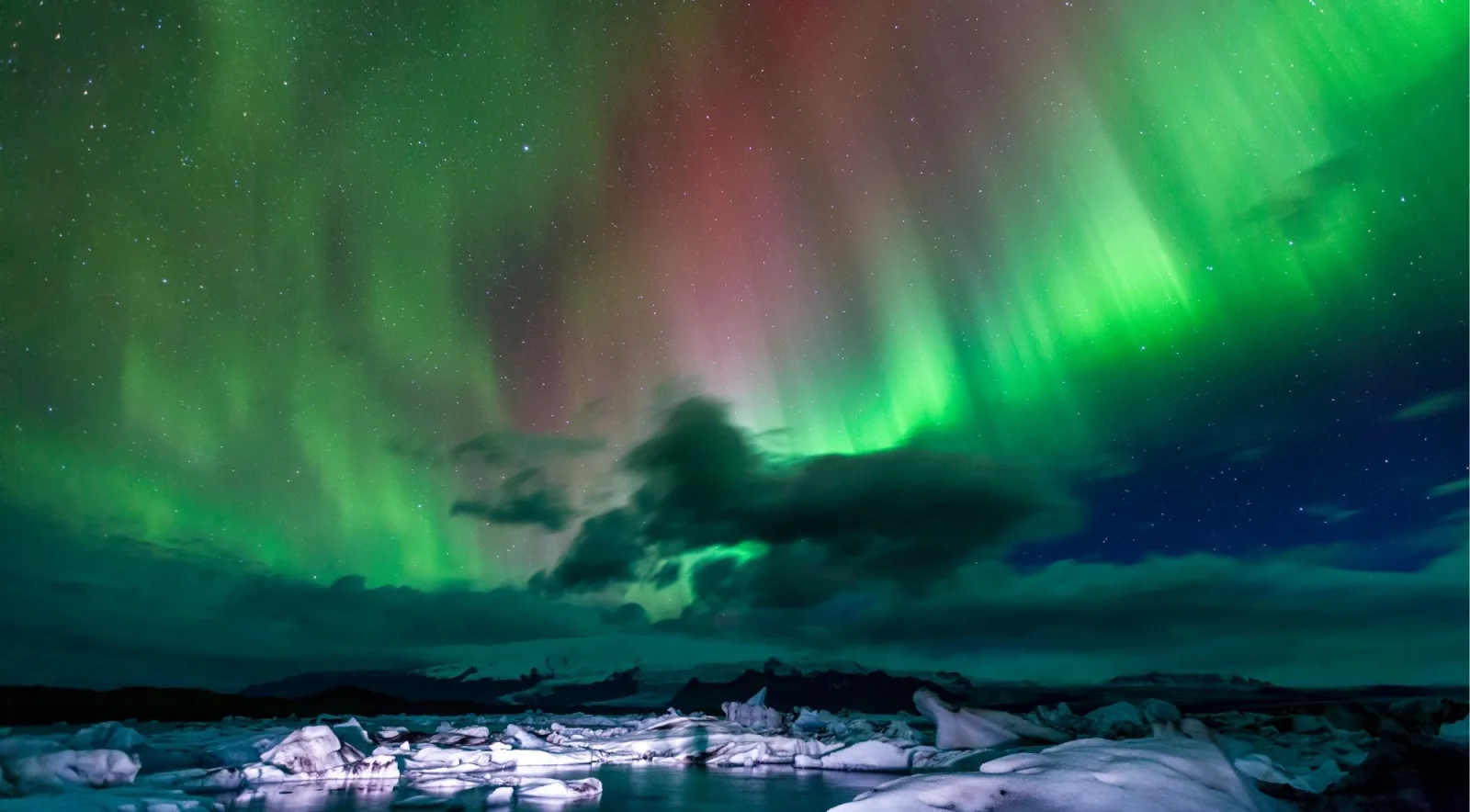
By November the nights are long, and cloud, not darkness, is the main limit. Use the Icelandic Met
Office's aurora forecast on vedur.is, which pairs a cloud-cover map (white areas mean clear skies)
with an activity index from 0 to 9. In the Met Office's words, even low activity (2) "can be
beautiful" and moderate (3) "can be dazzling." The new moon falls on 9 November 2026, so the darkest
skies run for roughly the first two weeks of the month. Staying overnight nearby is what makes an
aurora attempt realistic. Our northern lights at Jökulsárlón guide
and photography guide cover the spots and camera settings.
Seals
Harbour seals are the species you're most likely to see. The regional tourism office, Visit
Vatnajökull, notes that in winter the fish-filled lagoon "hosts numbers of seals, which visit the
lagoon for an easy meal." Watch the channel under the Route 1 bridge and the edges of the floating
ice. Our Jökulsárlón wildlife guide covers the other species.
Icebergs
Expect plenty of ice. Winter storms and cold air preserve icebergs on the beach, and the lagoon can
partly freeze during cold snaps. Ice levels change daily, so every visit looks different.
Fjallsárlón
Ten minutes west is Fjallsárlón, home to the Frost restaurant. Icelandtours.is lists 1,000 ISK Parka
parking there (location 7204), though the local boat operator says parking at its own lot is free of
charge, so check the signs when you arrive. In early November you may still catch its Zodiac tour;
later in the month, the frozen surface and glacier views are the draw. See Jökulsárlón vs Fjallsárlón for how the two lagoons
compare.
Where to Stay Near Jökulsárlón in November
There are fewer travellers in November, so you get more choice, but the options near the lagoon are
limited, and they are where the tours and the aurora are. Book early.
Hali
Country Hotel (Suðursveit): About 12–13 km east of the lagoon, open all year, with
35 rooms and a restaurant serving local farm food at the Þórbergssetur cultural centre.
Fosshotel
Glacier Lagoon (Hnappavellir): About 29 km west of the lagoon, a 4-star hotel
between Skaftafell and Jökulsárlón with a restaurant and bar.
Höfn:
About an hour east, with the most restaurants and services. A good base if you are continuing
along the Ring Road.
Skaftafell
and Hof area: A practical base for combining Skaftafell and Jökulsárlón, and it
qualifies for the 50% same-day parking discount.
Sample November Itineraries
1 day (if you're already in the southeast)
Arrive at the lagoon by around 10:00 for first light → walk the west shore and look for seals
→ cross to Diamond Beach around 11:30 → midday ice cave tour from the car park (the brightest
hours) → late lunch at the café or Fjallsárlón → back at your hotel before dark → aurora
check from 18:00 onwards.
2 days (self-drive from Reykjavík)
Day 1: Leave Reykjavík at first light, stopping at Seljalandsfoss, Skógafoss
and Vík. You'll reach Skaftafell around dusk; stay between Skaftafell and the lagoon and watch
for the aurora.
Day 2: Ice cave tour in the morning or at midday, then the lagoon, Diamond
Beach and Fjallsárlón. Stay a second night nearby instead of driving 5 hours back in the dark.
Add a third day as a weather buffer.
Bring a waterproof and windproof shell, an insulated mid-layer, thermal base layers, a warm hat,
gloves and a buff, and waterproof boots with good grip. Pack spare batteries, because the cold drains
them fast, and a head torch for walking at dusk. Ice cave operators supply helmets and crampons or
microspikes. Avoid jeans for glacier tours. The full list is in our what to
wear at Jökulsárlón guide.
Frequently Asked Questions
Partly. The Zodiac ends on 31 October. The amphibian boat is listed for "May–Nov", with
published hours only until 15 November, and it runs only if weather and ice allow. After
mid-November there are no boat tours on the lagoon until May.
Sometimes, but it is the least reliable part of the season. Tours may be bookable, but
cave access depends on sustained cold. Book from mid-November onwards if you can, choose
free cancellation, and schedule the tour on your first day in the area.
Yes, if a quiet lagoon and the chance of an ice cave and the northern lights matter more
to you than a boat ride. It is far quieter than summer, but the days are short and storms
can disrupt plans.
Around 8 hours on 1 November, falling to about 5½ hours by the end of the month. Sunrise
moves from around 08:40 to after 10:00, and sunset from about 16:50 to about 15:30.
Yes, on a guided bus tour of about 14 hours, but you won't have time for an ice cave, and
most of the day is spent driving in the dark. A 2-day tour is a much better use of
November.
Yes. It is free to walk and covered by the same parking payment as the lagoon. Stay well
back from the waves and off the ice in the surf.
Quite possibly. Harbour seals use the lagoon all year, and more are reported in winter.
Information checked in October 2026 against operator pages
(icelagoon.is, fjallsarlon.is and ice cave tour listings), Vatnajökull National Park and Parka parking
information, and Icelandic official safety and weather services (road.is, safetravel.is, vedur.is).
Seasons, prices and opening hours change, so always confirm directly before you travel.